

Field notes from my first research trip
And why it got me thinking of Harriet the Spy

“There are as many ways to live in this world as there are people in this world, and each one deserves a closer look.” - Ole Golly, in Harriet the Spy
Like any bookish girl born in the late 80s or early 90s, I worshipped Harriet the Spy. The Michelle Trachtenberg-starring movie adaptation came out when I was eight years old, a formative time. We moved to a tiny town in rural Pennsylvania that year from a small city in Connecticut, so the culture shock was real. I coped by spying.
Always one to carry a notebook around, I began using it as record of my spy activities. We lived on a big rambling plot of land that abutted acres and acres of wooded property owned by our town. My grandparents and great-grandfather lived across the driveway from us, and it seemed like they were always doing something outdoors: tending the garden, mowing the grass, fixing various things around the house or the garage. I had three sets of aunts and uncles and cousins that lived in town as well, so the driveway was a hotspot, cars and trucks constantly coming and going. I would make note of who came and went, what they were talking about or doing, and most importantly, I kept hidden.
I wanted to know and understand everything, down to the minute details that other people didn’t seem to care about, maybe because this place was new to me. This aptitude for observation, or, let’s be real, nosiness, was honed in those early years in Pennsylvania.
It turns out this set of skills really serves the writing of historical fiction.
Last week, I made the 3.5 hour journey from Newton to Hyde Park, New York to conduct my first in-person research at the Franklin D. Roosevelt Presidential Library. This isn’t your neighborhood library. It’s a stone cottage on the site of the gorgeous former Roosevelt family estate on the banks of the Hudson River, where the President used to house his personal study. Now, it’s home to over 17 million pages of documents, photographs, and books, including the personal papers of FDR and Eleanor Roosevelt (and many others who worked with and for them throughout their lives). A large chunk of the collection has been digitized (THANK GOD) so I’ve been fortunate to use a lot of that material in the first drafts of my book.
But along the way, I’ve come across things available in hard copy at the Library but not online: the diaries and scrapbooks of Myrtle’s boss, Press Secretary Steve Early, for example. And I also knew that being able to physically handle the very sorts of materials Myrtle was working on on a daily basis would give me a richness of texture and lived experience that viewing images online never could. (Plus, nosiness!) So I always planned to go do some research in-person when the time felt right.
Since the collection is so vast, researchers must notify the archivists on site (who are National Archives employees) well ahead of their visit, and submit requests for specific items in the collection so they can pull those and have them ready for you. I arrived on Thursday morning to a cart of ten large file boxes from my initial list, and then was able to request additional “pulls” throughout the day Thursday and Friday. All in all, I had time to go through 22 boxes out of the 40+ total I initially identified. This represented thousands of pages of material: diary entries, press conference transcripts, telegrams, memos, letters, memorabilia, news clippings, and more. I put my college-era scanning and skimming abilities to good use, taking over 600 photos with my phone of the artifacts I did think would be useful, so I didn’t have to spend my precious hours on-site reading them in full.
Press Secretary Early saved everything… and I mean everything. He kept scrapbooks from his time in the White House that contained every single news clipping that mentioned his name, as well as clippings related to notable world events in which the White House was involved. He also held a daily press conference over his twelve years as Press Secretary, and every single one of those transcripts is pasted in his scrapbooks as well.
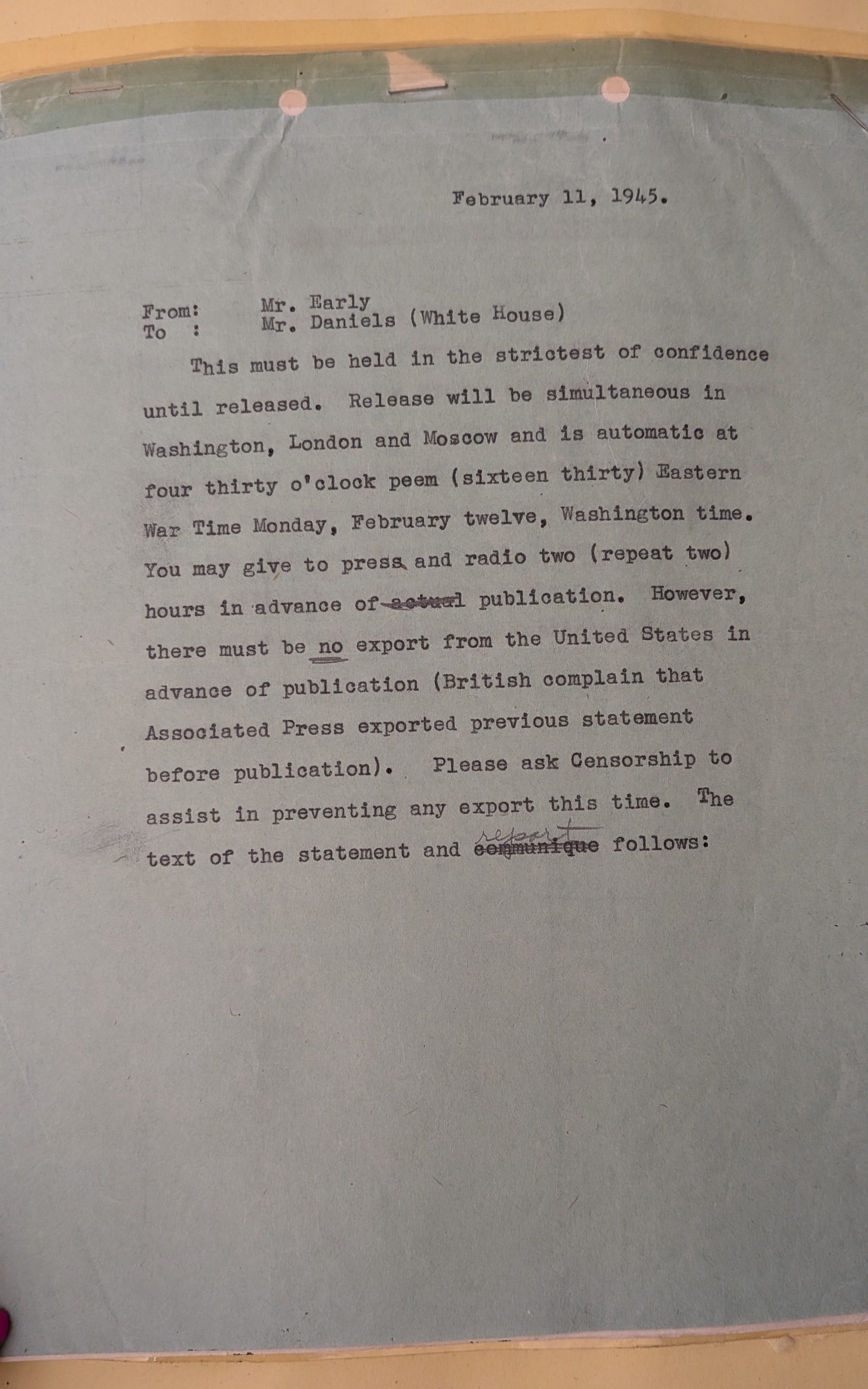
Some of the things I was able to handle felt truly momentous and special: the press release, with handwritten pencil notes in the margins, from the monumental conference at Yalta. To refresh your WWII memory, in case it’s been a while, that was the one where the Allied powers confirmed the final plans for defeating Nazi Germany, how Germany would be divided after the war, and basically invented the United Nations.
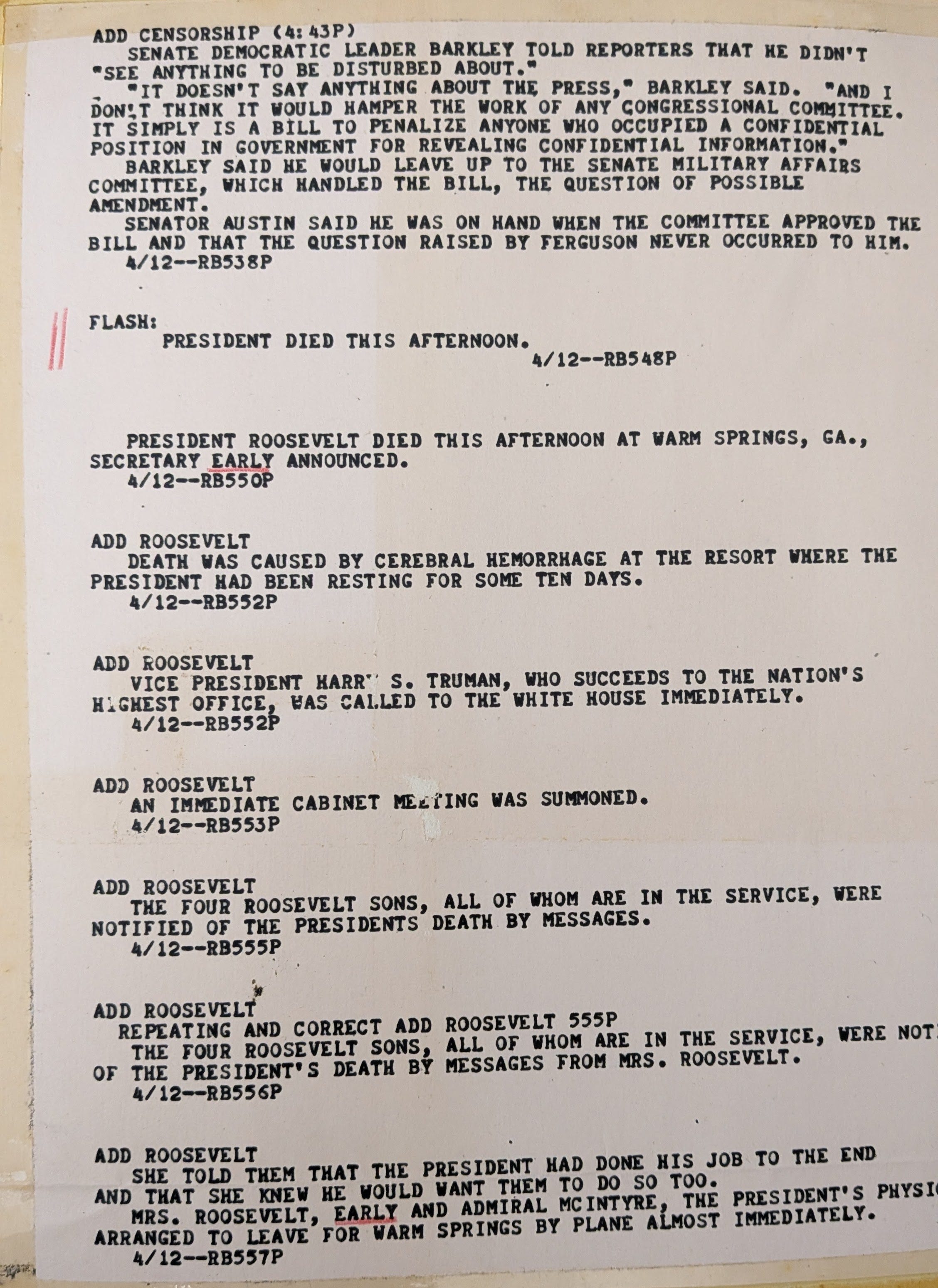
Below: a copy of the wire report (aka, OG Twitter) that came through when FDR died.
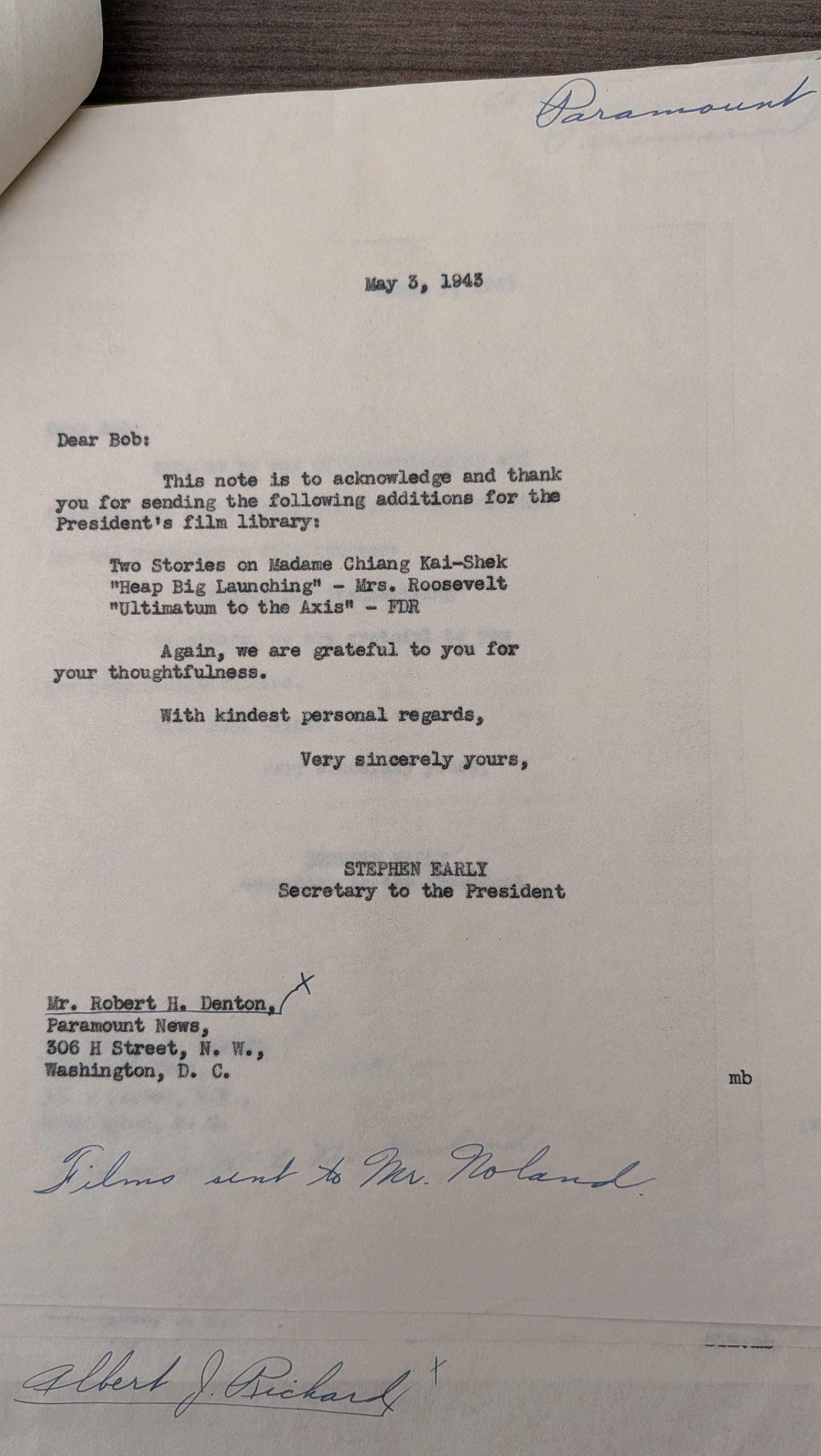
It was so fun to see the traces of Myrtle, too. Most of the time, it was easy to tell which documents she personally typed, because stenographers put their initials in the bottom right of typed copies.
When I saw the first “mb”, I felt like my eight-year-old self cosplaying Harriet the Spy or Nancy Drew, having discovered a clue. Here she was, in the form of those tiny letters. I noticed afterward that this one was typed on my birthday, forty-five years to the day before I was born.
I got so much material that I’ll be able to use in my book, and a deeper immersion in the cultural and social zeitgeist of the time, too. I particularly loved seeing old magazines (most of which are not available online, unless you want to scrounge around on eBay for them) complete with truly cringe advertisements and human interest stories.


The next day, I took the wonderfully immersive tour of Springbrook, FDR’s childhood home, where he and Eleanor raised their children, and where he spent over 200 weekends during his Presidency. Springbrook has been operating as a museum since exactly one year after FDR’s death; Eleanor was its first official tour guide. They preserved the house in exactly the condition it was when the family was still living there, so it’s chock full of amazing period details, art, and furniture that was serious catnip to me. The whole estate at Hyde Park was left to the nation in FDR’s will, so it became public property the day after his death.
That’s pretty astounding, in hindsight. The property, which is massive and fronts the Hudson, would be worth untold millions if sold. But anyone can go visit, and it’s free to walk around the grounds.


As any aspiring novelist knows, people love hearing about people writing books. Everyone I met in Hyde Park — employees at the library / museum, the owners of the bed & breakfast where I stayed — asked what I was doing in the area and were so generous with their support and questions when I told them about my book.
I had the loveliest conversation over breakfast with a mom and daughter pair who were spending the weekend together. Within three minutes of telling them about the premise of my novel, we were deep in a conversation about being eldest daughters and raising Jewish kids. Something about the vulnerability of writing a novel seems to get people to open up in ways they maybe wouldn’t otherwise. Or maybe the kind of people vacationing in upstate NY in March are just the right kind of people for me. Either way, I loved the whole experience, even if my neck and upper back were unexpectedly sore from all the bending over and peering at records for two straight days.
And it all culminated with a new goal. The tour guide at Springbrook told me about the annual Roosevelt Reading Festival, where authors whose books draw on research conducted at the library or focus on the Roosevelts, are invited to come talk about their books. Cue me manifesting that my next visit to Hyde Park will be to talk about my book, not just in the hypothetical sense.
Can you believe Harriet the Spy came out 30 years ago? I haven’t rewatched it in years and now I’m wondering how it’s aged…